

Career & Skill Education
September 5, 2026 · 5 min read
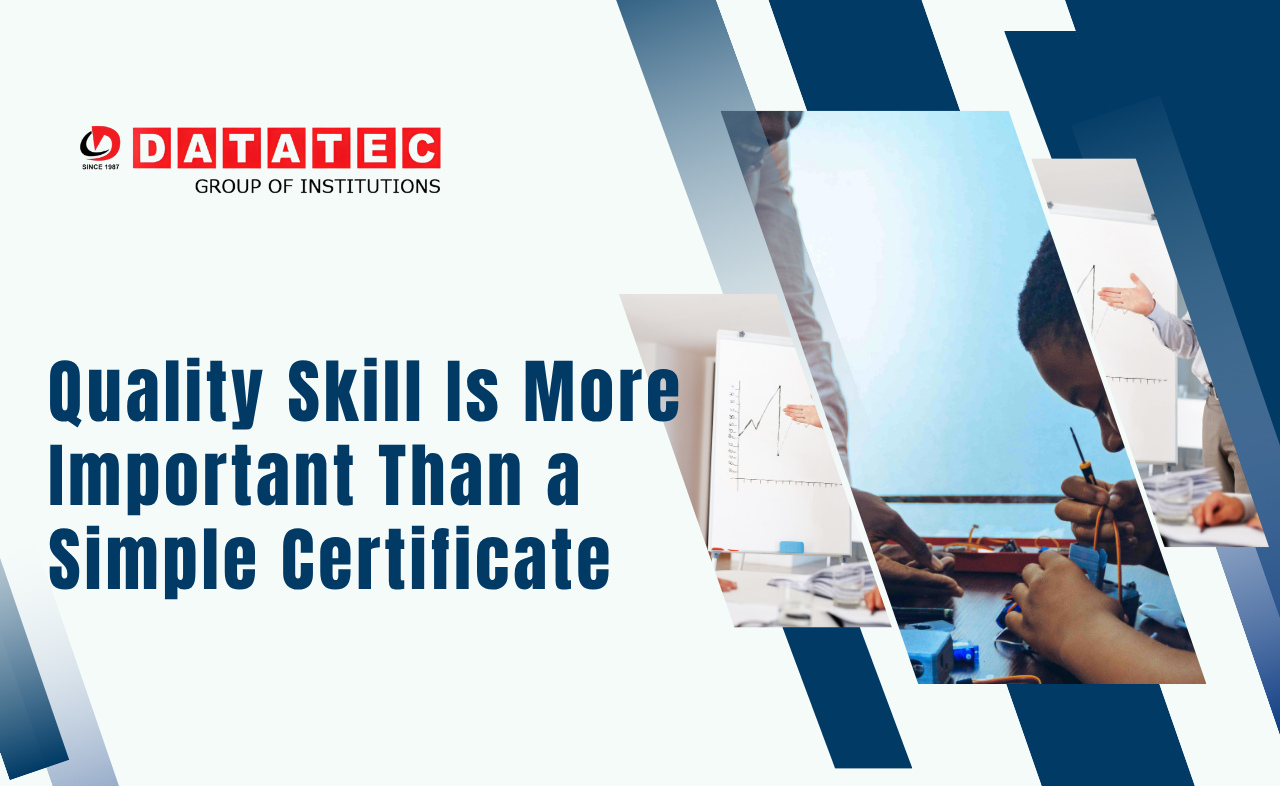
Getting a certificate after completing a course feels like an achievement — and it is.
But when it is time to attend an interview or start a job, one question becomes even more important:
“Can you actually do the work?”
Today, employers look for more than qualifications. They want people who can understand a task, use the right tools, solve problems, communicate clearly and learn new things when required.
That is why students searching for job-oriented courses in Kerala, computer courses in Mavelikara, ITI programmes or other skill development courses should not look at the certificate alone. The quality of the training matters just as much.
Certificate or Skill — Which Is More Important?
The simple answer is: both are important.
A certificate shows that you have completed a recognised course or programme. In some careers, it may also be needed for job eligibility, apprenticeships or further education.
A skill shows that you can use what you have learned in real life.
For example, a student may complete a Tally Prime + GST Course and receive a certificate. But in an actual workplace, the student may need to enter transactions, maintain accounts, understand GST, prepare reports and correct mistakes.
The same applies to programming. Knowing the theory is useful, but employers also want to know whether you can build something, identify errors and solve practical problems.
That is why good career education should move from:
Complete Course → Get Certificate
to:
Learn → Practise → Apply → Become Job Ready
Why Practical Training Makes a Big Difference
Think about learning to drive.
Reading a book about driving can help you understand the rules. But you only become confident when you actually sit behind the wheel and practise.
Skill training works in the same way.
A student may understand an accounting concept in class but still feel confused when using accounting software independently. A programming student may know coding basics but struggle to complete a real project.
That is why a good Skill Training Institute in Kerala should give students opportunities to practise through projects, lab sessions, assignments, real examples and industry-relevant software.
The goal should not be only to pass an exam.
The goal should be to make students confident enough to use what they have learned in the real world.
What Skills Do Employers Look For?
Technology is changing almost every type of job. AI, automation, digital tools, ERP systems and cloud platforms are becoming common in many industries.
Because of this, employers often look for people who have a good mix of knowledge and practical ability.
Some important skills include:
- Practical Knowledge: Knowing how to actually perform a task.
- Problem-Solving: Finding a solution when something goes wrong.
- Communication: Speaking and working clearly with customers, colleagues and managers.
- Adaptability: Learning new software, tools and methods when industries change.
- Professional Attitude: Being responsible, punctual, willing to learn and able to work with others.
These qualities can make a big difference between simply having a qualification and being ready for a career.
What Does Good Skill Training Look Like?
A good job-oriented course should not be only about textbooks and notes.
It should help students practise what they are learning.
For example, students doing a Tally Prime + GST Course should work with real accounting situations. Students learning Full Stack Development should build projects.
Students in Logistics and Supply Chain Management should understand inventory, warehousing and documentation, while Hospital Administration students should learn about hospital workflows, patient coordination and administration.
When students learn by doing, they understand the subject better and gain more confidence.
Choosing the Right Course After 10th or +2
Students completing 10th, +2 or Degree today have many options, including COPA & ITI, KGCE Engineering, Tally Prime + GST, SAP & ERP, Computer & IT, Full Stack Development, Hospital Administration, Logistics and CAD courses.
But the most popular course is not always the best course for everyone.
The right course should match your qualification, interests, strengths and career goals.
Before joining, ask simple questions:
- Who provides the certificate?
- Is practical training included?
- Will I work on projects or lab activities?
- Are current industry tools included?
- Is internship or apprenticeship support available?
- What career support is provided?
Most importantly, ask:
“What will I actually be able to do after completing this course?”
Students and parents looking for job-oriented courses in Mavelikara, Punalur and Kerala should consider practical training and career opportunities along with fees and location.
Explore Skill Courses at Datatec Skill Academy
Conclusion
A certificate and a skill should not be seen as two separate choices.
The strongest career foundation comes from combining:
Recognised Certificate + Practical Skill + Experience + Continuous Learning
A certificate may help you become eligible for an opportunity.
Practical skills help you use that opportunity with confidence.
And continuous learning helps you grow as technology and industries change.
A certificate can add a qualification to your résumé.
A quality skill can help you build a career around it.
Explore career-focused programmes through Datatec Skill Academy Courses.